















The Mediterranean olive oil market is navigating a pivotal transition into the 2026/2027 campaign. Following a record Tunisian harvest of over 460,000 tonnes and export revenues exceeding 4.6 billion TND, producers, millers, and global traders are recalibrating pricing benchmarks amid shifting global supply dynamics.
1. Global Supply Dynamics: Rising Regional Powerhouses & Syrian Recovery
Global supply is no longer dictated solely by traditional European producers (Spain and Italy). Southern and Eastern Mediterranean nations have emerged as vital contributors:
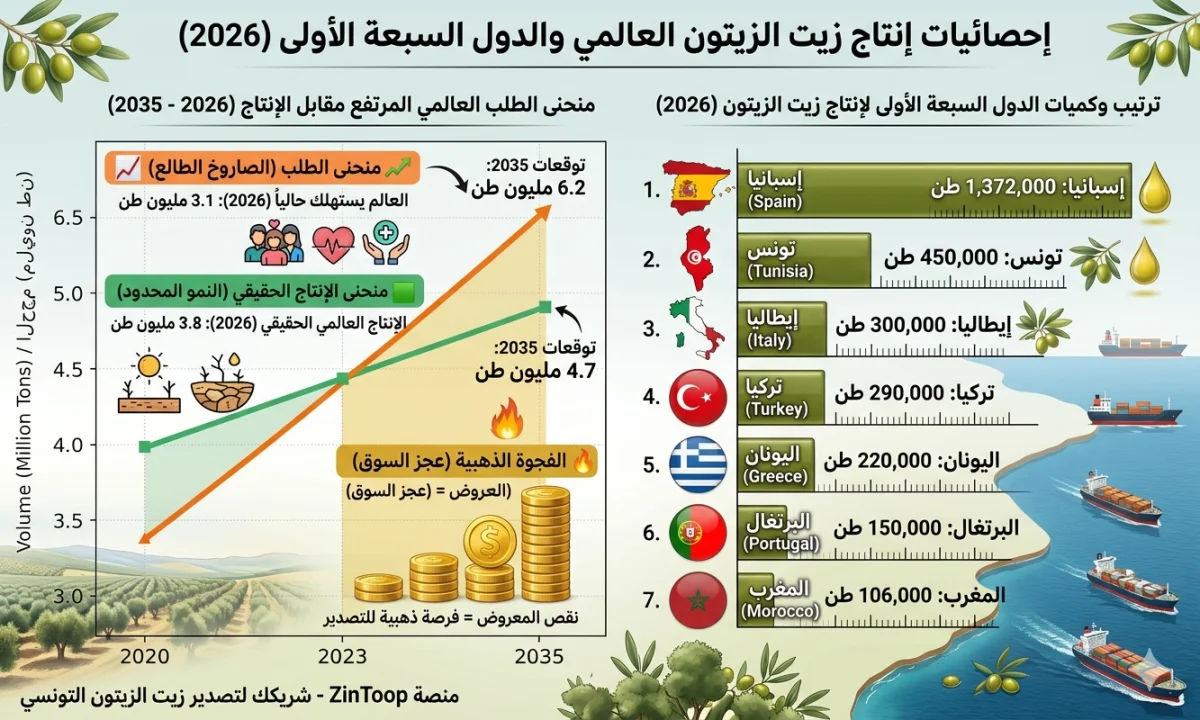
- Spain (Global Benchmark 40-45%): Early field assessments indicate a normalized production between 1.35 and 1.45 million tonnes.
- Tunisia (Southern Mediterranean Leader): Following historic volumes, the national crop enters its natural biennial alternation cycle, stabilizing around 280,000 to 320,000 tonnes—providing robust domestic security and over 240,000 tonnes for export.
- Turkey: Anticipated volume of 350,000 to 400,000 tonnes, driving competitive bulk flows.
- Morocco (140,000 - 160,000 tonnes): Expanded modern irrigated acreage under national agro-initiatives solidifies regional supply alongside strong domestic demand.
- Algeria (100,000 - 130,000 tonnes): High-density inland plantings spanning over 500,000 hectares increase export availability.
- Egypt: World leader in table olives, expanding mechanical extraction capacity for extra virgin bulk.
- Syria's Agricultural Recovery (100,000 - 130,000 tonnes): Rejuvenated groves in Idlib, Afrin, and coastal valleys restore regional olive oil trade corridors.
- Saudi Arabia (Al-Jouf): Over 25 million super-intensive trees targeting Gulf regional consumption.
- Portugal & Southern Hemisphere (Chile, Argentina, Australia): Super-intensive developments providing counter-cyclical supply.
2. Global Supply vs Demand Balance: The Macro Mechanics
- Global Annual Demand: Baseline global olive oil consumption stands between 3.0 and 3.2 million tonnes annually.
- The 3% Reality: Olive oil represents only 3% of worldwide vegetable oil consumption, making it an elastic premium commodity.
- Deficit Years (< 2.8M tonnes): Triggers severe price spikes, forcing price-sensitive retail consumers toward blended seed oils.
- Balanced Years (3.1 - 3.3M tonnes): Restores equilibrium and stimulates steady consumption across European, North American, and Asian import markets.
3. The Economic Dilemma: Why Farmers Sometimes Sell Below Production Cost
While official farm organizations calculate average EVOO production costs between 12.5 and 14.0 TND/L, growers are occasionally forced into distressed sales due to 4 structural hurdles:
- Acute Cash Flow Pressure: Harvesting and transport labor represents 40% to 50% of total production cost, payable in daily cash wages. Smallholders frequently liquidate fresh harvest immediately to settle labor payroll.
- Fruit Perishability & Oxidation Risks: Fresh olives degrade rapidly if bagged beyond 48 hours, causing fermentation and degrading EVOO into lampante grade.
- Lack of Seasonal Working Capital: Limited access to short-term harvest credit restricts smallholders from storing bulk oil in certified tanks for off-season premium sales.
- Peak Harvest Speculation: During December and January, processing bottlenecks allow informal aggregators to enforce artificial price discounts on distressed farmgate sellers.
4. Extraction Yield (Tabouiz) & Farmgate Olive Pricing Matrix
| Harvest Stage & Quality | Extraction Yield (%) | Oil per Quintal (100 kg) | Fair Farmgate Olive Price | Resulting Oil Grade |
|---|---|---|---|---|
| Early Harvest (Oct - Nov) | 13% - 15% | 13 - 15 Liters | 1.70 - 2.00 TND / kg | Ultra Premium Early Green Fruity |
| Peak Season (Dec - Jan) | 18% - 20% | 18 - 20 Liters | 2.20 - 2.60 TND / kg | Standard Commercial Extra Virgin |
| Late Harvest (Feb - Mar) | 22% - 25% | 22 - 25 Liters | 2.60 - 3.10 TND / kg | Ripe Virgin High-Oil Yield |
5. Mill Economics (Prix de Base & Processing Fees)
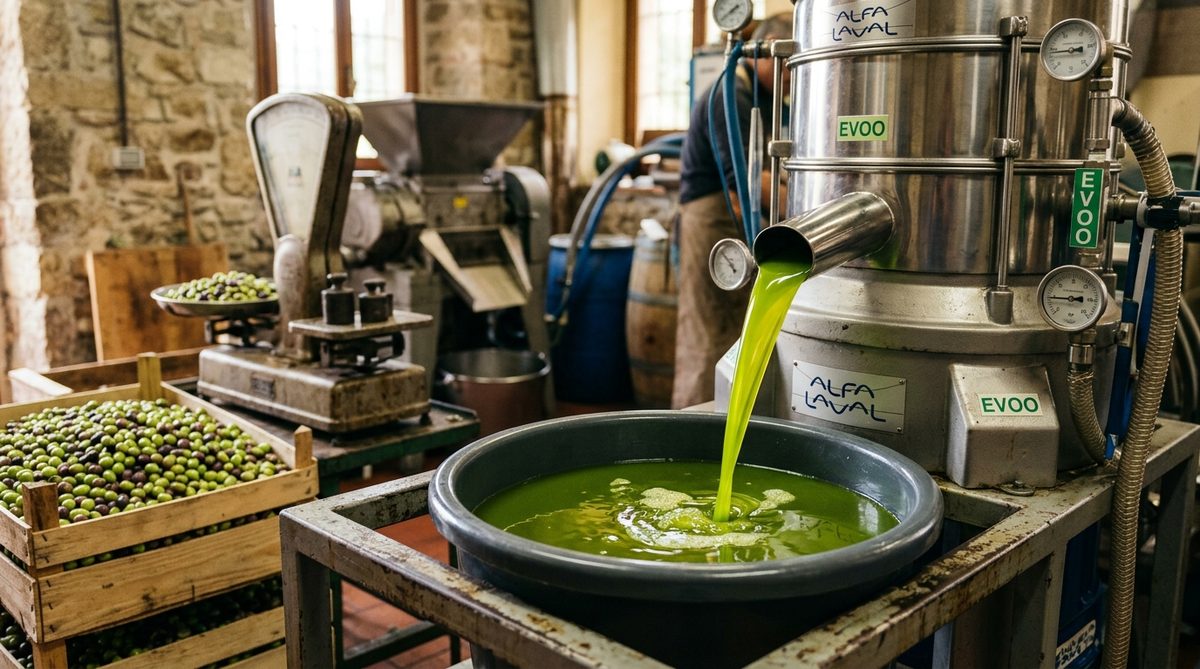
- Trituration Fees: Ranges between 150 and 220 millimes per kg of raw olives (15 - 22 TND per quintal) or an in-kind retention of 8% to 10% of extracted oil.
- Base Pricing (Le Baz): Mills calibrate live purchasing prices directly to NIR Soxhlet oil yield tests and prevailing bulk tank contracts.
- Millers' Safety Margin: Maintaining a buffer of 0.600 to 0.800 TND/L against bulk export sales covers energy, labor, and equipment depreciation.
6. True Cost of Production by Quality Grade
| Grade | Technical Specification | Real Cost of Production (TND/L) | Fair Equilibrium Price (TND/L) |
|---|---|---|---|
| Ultra Premium EVOO | Early harvest, cold-pressed, acidity < 0.3% | 14.50 - 16.00 TND | 17.00 - 22.00 TND |
| Standard Extra Virgin | Milled within 24h, acidity < 0.8% | 12.50 - 13.50 TND | 14.00 - 16.00 TND |
| Certified Organic (Bio) | Zero chemicals, international certification | 13.50 - 15.00 TND | 16.50 - 19.50 TND |
| Virgin Olive Oil | Acidity between 0.8% and 2.0% | 10.50 - 11.50 TND | 11.50 - 13.00 TND |
| Lampante Oil | Industrial refining grade, acidity > 2.0% | 8.50 - 9.50 TND | 9.50 - 10.50 TND |
7. 2026/2027 Market Outlook Scenarios
- Bullish Scenario (Mediterranean Harvest Deficit): Should drought constrain European harvests, Tunisian bulk EVOO will trade at 15.50 - 17.50 TND/L (€3.80 - €4.50/kg FOB).
- Baseline Scenario (Balanced Supply & Demand - Most Probable): World production around 3.1M tonnes and Tunisian crop near 300,000 tonnes establishes bulk EVOO at 13.00 - 15.00 TND/L at mills and farmgate olives at 2.20 - 2.60 TND/kg.
- Bearish Scenario (Spanish Super-Harvest & Buyer Pressure): Spanish output exceeding 1.55M tonnes could soften bulk prices to 11.00 - 12.50 TND/L, reinforcing the necessity of stainless-steel storage, organic certification, and value-added retail packaging.
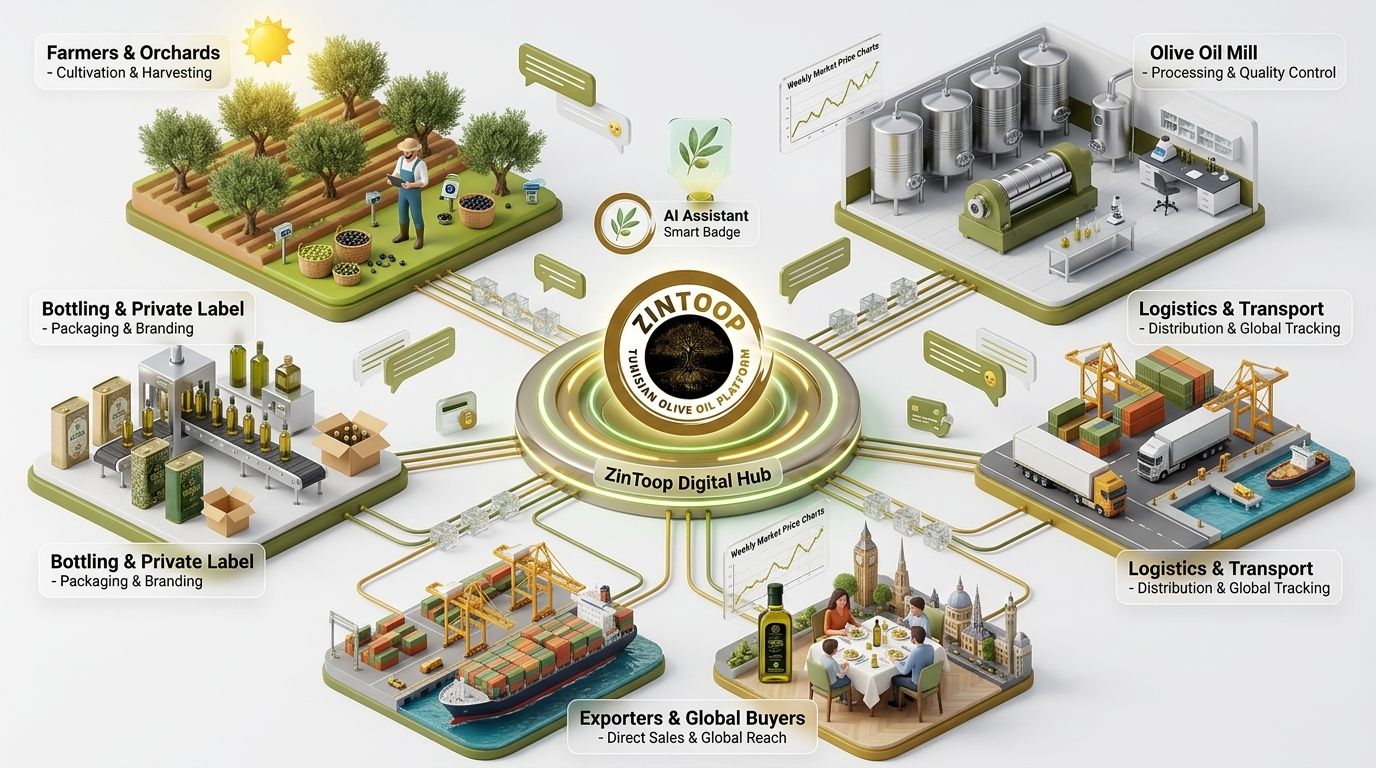
8. How ZinToop Protects Farmers and Millers
- Direct Forward Trading (0% Commission): Direct interaction between growers, millers, and verified buyers.
- Transparent Weekly Price Index: Ground-truth price monitoring across all Tunisian governorates.
- Certified Logistics & Lab Verification: Streamlined transport coordination and certified COA testing to capture maximum quality premiums.
Track live weekly market prices: https://zintoop.com/en/prices